
How Often Should You Service Mechanical Watches?
A mechanical watch can appear to be keeping good time while its lubricants are already beginning to degrade. That is why the question of how often to service mechanical watches cannot be answered by the calendar alone. A Rolex worn daily through a British winter, an Omega Speedmaster used only at weekends, and a vintage Tudor kept in a collection cabinet may each need very different attention.
For collectors, servicing is not simply a matter of preserving accuracy. It protects originality, helps prevent avoidable wear to costly components and supports the long-term desirability of a watch. The right approach is measured rather than automatic: service when the watch's age, use and condition justify it, using a watchmaker who understands the particular reference.
How often should you service mechanical watches?
For most modern mechanical watches, a sensible working interval is around five to ten years. The broader range matters. Manufacturer recommendations commonly sit around this point, but they are guidelines based on normal use, not a fixed expiry date for every movement.
A watch worn every day, exposed to moisture, shocks, magnetism and frequent crown operation will usually sit nearer the five-year end of the range. A modern watch that is lightly worn, remains accurate and has passed a water-resistance check may comfortably run longer. Servicing a healthy movement unnecessarily early can introduce risk, particularly where original components, dial condition and case finishing are important to value.
Older watches deserve a more individual assessment. A vintage Rolex Datejust, Omega Seamaster or manually wound dress watch may have unknown service history, aged seals and parts that are no longer readily available. In this case, a condition check by a competent independent specialist is more useful than following a universal interval. If the watch has recently been acquired without clear servicing evidence, an inspection is prudent even if it appears to be functioning well.
What a proper service actually addresses
Mechanical movements operate through a controlled interaction of pivots, wheels, springs and lubricants. Over time, lubricants can dry, migrate or lose their protective qualities. Friction then rises, which can affect amplitude, rate stability and the condition of moving parts.
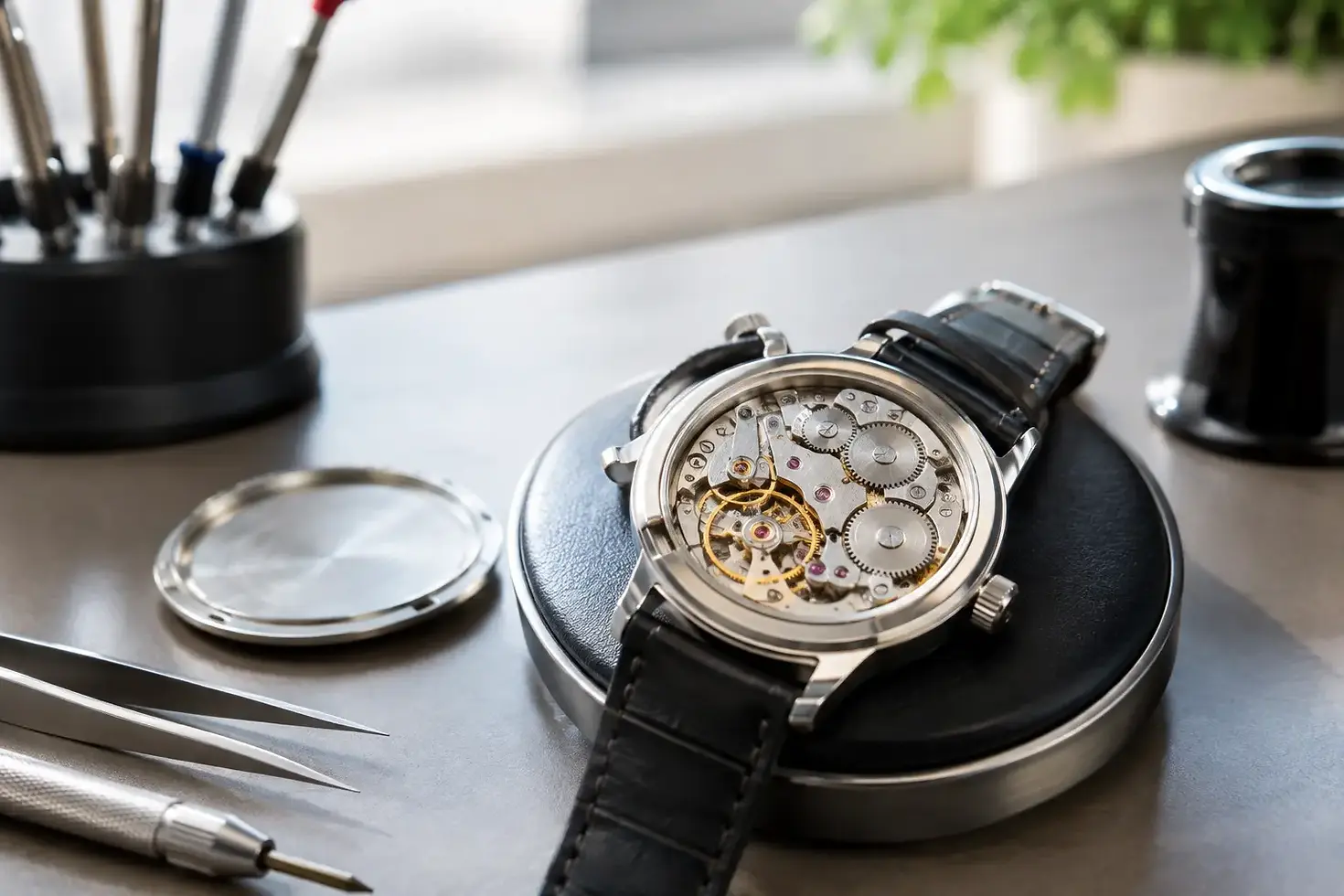
A full service normally involves dismantling the movement, cleaning the individual components, inspecting for wear, replacing any unsuitable parts, reassembling and lubricating the movement, then regulating and testing it. On a water-resistant watch, the seals should also be assessed and replaced where necessary before pressure testing.
The external work requires equal care. A collector-grade watch does not automatically benefit from refinishing. Sharp case lines, original bevels, factory brushing and honest signs of age can all be part of its appeal. A good service discussion should distinguish movement work from cosmetic work, rather than treating polishing as an assumed part of the process.
Service and restoration are not the same thing
A service aims to return reliable mechanical performance while retaining as much appropriate originality as possible. Restoration can be more invasive, potentially involving replacement hands, reluming, dial work, case refurbishment or bracelet repair.
These decisions have different implications for a modern daily wearer and a rare vintage reference. Replacing deteriorated luminous material may improve appearance, but it can materially change collector value. Likewise, fitting a replacement dial or polishing an unpolished case may be difficult to reverse. Ask exactly what is proposed before authorising work, and request the return of any replaced original parts where possible.
Signs that your watch should be checked sooner
Timekeeping is the most obvious signal, but it is not the only one. A modern chronometer may vary slightly from day to day according to position and power reserve, yet a noticeable change from its established behaviour warrants attention. A watch that begins losing several minutes per day, stops unexpectedly, or has a reduced power reserve should not simply be worn until its next planned service.
Condensation under the crystal requires immediate action. Moisture can damage the dial, hands and movement rapidly, particularly in older watches with compromised gaskets. Do not attempt to dry it on a radiator or continue winding it. Keep the watch dry and arrange professional assessment promptly.
Other warning signs include resistance or roughness when winding, a crown that will not screw down correctly, unusual rotor noise, stiff pushers, a date that changes irregularly, or a chronograph hand that fails to reset precisely. Any impact strong enough to mark the case or crystal can also affect the movement, even when the watch continues to run.
For watches used in water, annual water-resistance testing is often more relevant than annual mechanical servicing. Seals age independently of movement condition. A diver that regularly enters the sea, pool or shower should have its water resistance checked each year and after any impact. Water resistance is a condition to be maintained, not a permanent specification.
Usage changes the service interval
A watch that spends most of its life in a safe is not necessarily maintenance-free. Oils still age, and a dormant watch with a weak mainspring or dried lubrication may suffer when it is eventually put back into regular rotation. However, low use does reduce exposure to shocks, contamination and moisture.
Daily wear creates a different set of demands. Automatic watches benefit from regular winding through normal use, but they are also more likely to encounter knocks, temperature changes and magnetic fields from mobile phones, laptops, speakers and bag clasps. Modern movements are generally better protected than their vintage counterparts, but magnetisation can still cause abrupt changes in rate.
Manual-wind watches need thoughtful handling. Wind them at a consistent time, stop when the crown reaches its natural limit and avoid forcing it. For complicated watches, especially perpetual calendars, avoid attempting corrections without understanding the movement's safe setting period. A costly error can be avoided with a brief conversation with a qualified watchmaker.
Choosing the right route for servicing
The best service route depends on the watch, its age and the owner's priorities. A manufacturer service centre can provide factory procedures, access to current parts and a formal service warranty. For modern watches still under manufacturer warranty, or for pieces where water resistance and replacement parts are the primary concern, this can be the right choice.
An experienced independent specialist may be preferable for an older or collector-focused watch, particularly where preservation of original parts and case geometry is paramount. The key is not simply choosing the cheapest quotation. Ask whether the watchmaker has experience with the relevant calibre, whether replacement parts require approval, what finishing work is included, and whether pressure testing and timing results will be documented.
A transparent estimate should separate essential mechanical work from optional cosmetic work. That distinction is particularly valuable when servicing watches with tritium dials, faded bezels, early bracelets or unpolished cases. Provenance is more than a box and papers: it is also the survival of the correct physical details.
Keep a service record worth having
Retain invoices, timing reports, pressure-test results and correspondence about work completed. For a watch intended to remain in a collection or eventually be sold, this creates a useful ownership record. It gives the next owner confidence that the movement has been cared for and that major interventions were considered rather than casually undertaken.
This does not mean every service increases value by its full cost. On many watches, service expenditure is maintenance, not an investment return. But an overdue movement, water damage or indiscriminate replacement of original components can be far more expensive in the long run.
For pre-owned purchases, ask when the watch was last serviced and what evidence exists. A seller's statement that it is "running well" is not the same as a documented service. At Hora Watches, careful inspection and transparent condition reporting are central to assessing pre-owned timepieces, but owners should still maintain their own records once a watch enters their collection.
A mechanical watch rewards observation. Wear it, note how it performs, protect it from water where its seals are unproven, and treat a change in behaviour as useful information rather than an inconvenience. The best service interval is the one that preserves the watch before minor wear becomes consequential.


Comments