
What Is a Full Set Watch? A Buyer’s Guide
A desirable Rolex, Omega or Tudor can look complete at first glance, yet the phrase full set carries more weight than a presentation box beside the watch. For collectors and buyers considering a significant pre-owned purchase, understanding what is a full set watch helps separate a properly documented example from one that is merely accompanied by a few accessories.
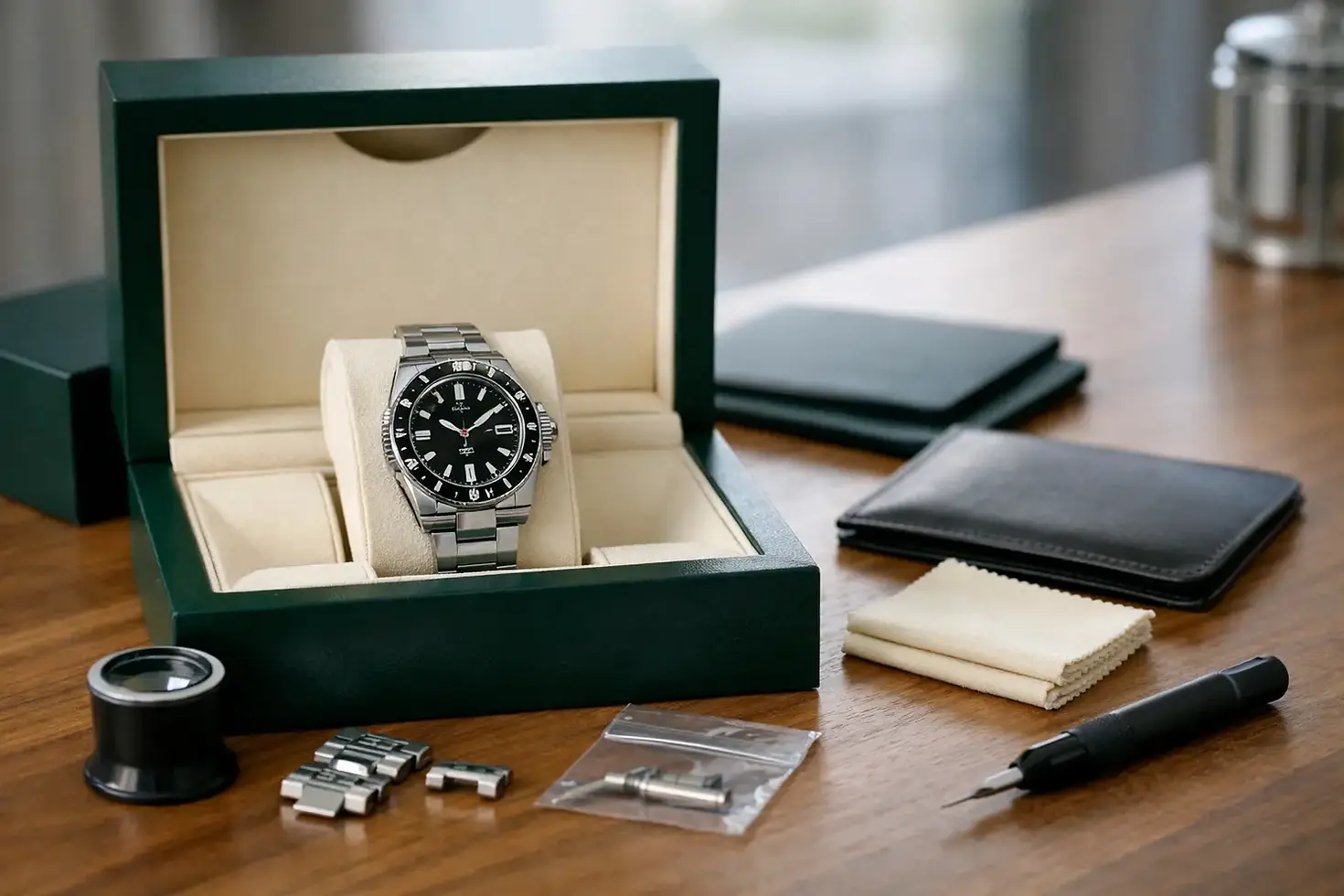
In its simplest form, a full set is a watch offered with the items supplied when it was first sold. These usually include the original box, warranty card or papers, instruction booklet, swing tags and any model-specific accessories. The exact contents vary by brand, era, market and reference, so the term should always be supported by a clear description of what is actually present.
What is a full set watch?
A full set watch is generally understood to be the watch, its original presentation box, and its original papers or warranty documentation, along with the relevant accessories supplied at retail. In the modern luxury market, the warranty card is often the most significant non-watch component because it can confirm the original date of sale, supplying dealer and, in many cases, the watch’s serial number.
That said, full set is not a universal factory standard. Rolex packaging and documentation have changed repeatedly over the decades. Omega’s contents can differ according to the model and period, while a Grand Seiko may have regional paperwork or supplementary documentation that is less familiar to a UK buyer. A dealer should therefore describe the set precisely rather than relying on the phrase alone.
For a contemporary steel sports watch, a strong full set might include the outer sleeve, presentation box, warranty card, booklets, green seal, swing tags and spare bracelet links. For a vintage piece, expecting every original booklet and tag may be unrealistic. An original punched warranty paper and period-correct box can be exceptionally desirable, but the watch may still be collector-grade without every item that left the retailer decades earlier.
Why a complete set matters
The watch remains the principal asset. Its originality, condition, mechanical performance and desirability matter more than packaging. However, a complete set adds a credible layer of provenance, and this can materially influence buyer confidence, future saleability and market value.
Original papers are especially useful when their details align with the watch. A matching serial number, an appropriate sale date and consistent retailer information provide reassurance about the piece’s history. They do not replace professional authentication, but they form part of a more coherent ownership record.
Completeness also affects how readily a watch may sell later. Two comparable examples of the same reference, age and condition will often attract different levels of demand if one retains its original box and papers while the other is watch-only. This is particularly true for sought-after Rolex Professional models, limited or discontinued Omega references, rare dial variants and watches bought by collectors rather than purely for daily wear.
The premium is not fixed. For a current-production model, the difference may be modest if the watch is excellent and correctly priced. For an early Submariner, vintage Speedmaster or a scarce Tudor reference, original paperwork can be a defining part of the proposition. It depends on the model, its production period, rarity and the quality of the accompanying material.
Full set does not always mean better value
A full set should strengthen a purchase, not distract from the watch itself. An over-polished case, replacement dial, incorrect hands or poor movement performance cannot be excused by an attractive box and card. Equally, an honest watch-only example with strong case proportions, original components and a documented service history can be the more intelligent purchase.
This distinction matters most with vintage watches. Period boxes are collectable in their own right and are sometimes sold separately. A box that is correct for the era is not necessarily the box originally supplied with that watch. The same caution applies to loose booklets, tags and certificates. Their presence may add appeal, but only matching documentation creates a direct connection to the individual timepiece.
There is also a practical trade-off. A buyer focused on wearing a modern watch regularly may prefer to allocate their budget towards condition, a full bracelet, recent servicing and a reputable seller rather than paying a substantial premium for peripheral items. A collector building a long-term, reference-led collection may reasonably take the opposite view.
What to check in a full set watch
The most reliable approach is to assess the contents alongside the watch, rather than treating them as separate additions. Start with the warranty card or certificate. Where applicable, check that its serial number corresponds with the watch and that the stated reference is correct. Confirm that the date is plausible for the model and that the card format is consistent with the period of production.
Then consider the box. Is it original to the brand and broadly appropriate to the watch’s era? For modern pieces, an inner and outer box are commonly expected. For older watches, packaging varies considerably, and condition should be judged fairly. A slightly worn but genuine period box is usually more meaningful than a pristine replacement.
Accessories should be described with the same care. A bezel protector, hang tag, chronometer seal, wallet, instruction booklet, service booklet and spare links can all be useful, but their relevance differs by reference. A dive watch’s extension link or a precious-metal model’s removed bracelet links may have greater practical value than a generic leaflet.
Finally, ask how the watch itself has been examined. Documentation is only one part of provenance. A properly offered pre-owned watch should have its reference, serial details where appropriate, movement, case, bracelet and overall condition assessed by a knowledgeable specialist. The selling description should be clear about polishing, replacement parts, service history and any condition points that may affect collector value.
Original papers, service papers and extracts
These documents are often confused, although they serve different purposes. Original warranty papers or a warranty card were issued at the point of first retail sale. They are normally the most desirable form of paperwork because they relate to the watch when new.
Service papers record work carried out later by a manufacturer or watchmaker. They can be valuable evidence of maintenance and may offer a warranty on that work, but they do not make a watch a full set if the original warranty documentation is absent. They should be viewed as useful supporting history.
Some brands can provide archival extracts or extracts from their archives. These may confirm production details or an original delivery date, depending on the brand and period. Such extracts can be highly informative for vintage collectors, though they are not a substitute for original papers and should not be represented as such.
How terminology should be used when buying pre-owned
Clear language protects both buyer and seller. Full set should mean that the original retail package is substantially present, with the important elements disclosed. If a warranty card is missing, the watch is more accurately described as box and papers absent, or as supplied with box only, depending on the contents. If it comes with a service card but no original warranty card, that distinction should be explicit.
A careful dealer will also distinguish between original and period-correct accessories. This is particularly relevant to vintage Rolex and Omega, where the phrase period-correct may be entirely appropriate but does not prove that an item accompanied the watch from new.
At Hora Watches, complete sets are assessed as part of the wider condition and provenance of each timepiece. Meticulous authentication and transparent descriptions matter because a collector should know precisely what they are buying, whether that is an unworn modern full set or an exceptional watch-only vintage reference.
The right question to ask before you buy
Rather than asking only whether a watch is a full set, ask what is included, what can be verified as original to that specific watch, and whether the price reflects the difference. Request a clear inventory of the set and compare it with the reference, age and condition of the watch.
For many buyers, a complete set offers the most reassuring route into a valuable pre-owned purchase. For others, the right watch will be the one with the strongest fundamentals, even if a box or booklet was lost long ago. Buy the example whose condition, provenance and completeness suit the way you intend to enjoy it - and keep every item together once it is yours.


Comments