
Five Signs of Original Watch Parts to Check
A Rolex Submariner can carry the correct reference number, a convincing bezel and a respectable service history, yet still be materially less desirable because its dial, hands or bracelet are later replacements. Knowing the five signs of original watch parts helps separate a watch that is merely genuine from one that is coherent, correctly represented and properly valued.
For collectors, originality is rarely an all-or-nothing judgement. A period-correct replacement crown may be entirely acceptable on a watch intended for regular wear. A service dial fitted by the manufacturer may be genuine, but it can alter both the appearance and collector value of a vintage reference. The right question is not simply, “Are the parts real?” It is, “Do these parts belong on this particular watch, and has any change been disclosed?”
Five signs of original watch parts
1. The dial matches the reference, production period and configuration
The dial is often the first component a knowledgeable buyer studies, and for good reason. It defines the watch visually and can account for a substantial proportion of its collector appeal. On a vintage Omega Speedmaster, for example, the correct dial layout, logo style, minute track and luminous material must align with the reference and approximate production period. On Rolex, small details such as typography, coronet shape, dial feet position and the wording at six o'clock can distinguish an original dial from a later service item or an altered example.
A correct-looking dial is not automatically an original one. Redials can be highly persuasive in photographs, particularly where printing has been copied from a known original. Uneven text, poor spacing, overly bright luminous plots or a finish that appears too fresh for the case and hands should prompt further examination. Equally, do not assume that age alone proves originality. Natural patina is desirable only when it is consistent and credible.
There is also a practical trade-off. Some owners prefer the clarity and reliability of a manufacturer service dial. That may make excellent sense for a watch bought to wear, but it should be described accurately and reflected in the price. For a collector-grade piece, the original dial is generally the stronger proposition, even where it shows honest age.
2. The hands and luminous material age together
Hands are frequently replaced during servicing because they are exposed, delicate and important to legibility. A replacement set may be genuine and correctly fitted, yet it can still affect originality. The useful test is whether the hands make sense alongside the dial, rather than whether they look tidy in isolation.
On tritium-era watches, the luminous material on the hands and hour plots should normally show broadly compatible ageing. Perfectly white hands against warm cream plots may suggest replacement hands. A pronounced colour difference does not always mean a problem: tritium can age differently depending on thickness, exposure and storage. However, a significant mismatch deserves an explanation.
Look beyond colour. The length, profile, central hole and finish of the hands should match the reference. On a Tudor or Rolex sports watch, incorrect hands may have a slightly different shape or reach too far across the minute track. On a Grand Seiko, the crispness of the hands and the quality of their facets are particularly revealing. Poorly refinished hands often lose the sharp, light-catching edges that give the original design its precision.
Matching lume is not a substitute for expert inspection. Lume can be stabilised, repaired or artificially aged. It is one part of a wider assessment, best considered with the dial, case condition and documented history.
3. The case retains the correct geometry and markings
A watch case is expected to show use. What matters is whether it still retains the architecture intended by the manufacturer. Over-polishing can soften chamfers, reduce the definition of lugs and blur the transition between brushed and polished surfaces. These changes are sometimes subtle, but on references valued for their case design, they have a real bearing on collectability.
Originality also extends to the caseback, bezel, pushers and crown. A correct crown should be proportionate, correctly signed where applicable and suitable for the period. A later service crown may improve water resistance, which is a sensible choice for a watch worn regularly, but it should not be presented as an original component. The same applies to replacement bezels, especially on vintage dive watches where inserts, fonts and ageing characteristics are closely studied.
Serial and reference markings should be consistent with the watch and should not appear disturbed, overly shallow or unusually fresh relative to surrounding surfaces. Their presence alone proves little, since counterfeit cases can carry convincing numbers. Instead, assess the total picture: case proportions, engraving quality, construction, wear patterns and whether each external component agrees with the reference.
4. The movement is correct, properly finished and appropriately marked
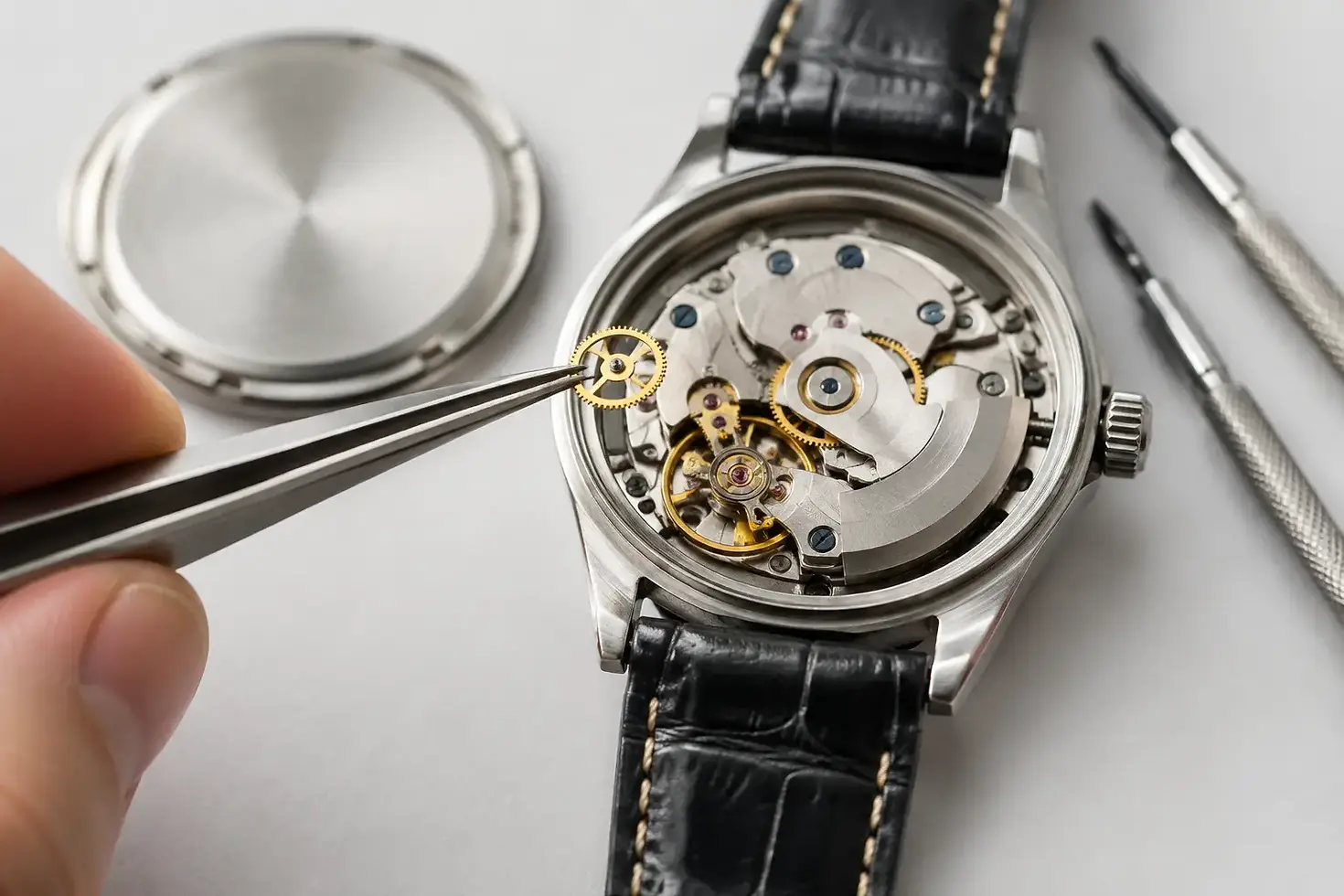
The movement is the mechanical identity of the watch. Its calibre should correspond to the reference, its bridge layout and finishing should be consistent with the manufacturer, and its serial number should sit within a plausible production range where records allow. A correct movement does not guarantee that every visible component is original, but an incorrect calibre is an immediate concern.
Authentic movements also reveal the quality of past ownership. Incorrect screws, heavily marked bridges, rough tool damage or mismatched components can indicate poor intervention. Some service parts are unavoidable and entirely legitimate: mainsprings, seals, jewels and worn wheels are consumable items, and responsible servicing often requires replacement. Their presence should not be treated as a defect.
The distinction is between maintenance and substitution. A watch with a sympathetically serviced original movement can be more desirable and more dependable than one left untouched for decades. What a buyer needs is clarity about what has been replaced, the quality of the work, and whether the movement remains correct to the watch.
5. The bracelet, clasp and accessories support the watch's story
Bracelets are often overlooked, despite being both expensive and reference-specific. Check the clasp code or date stamp where applicable, the end-link numbers, the construction of the links and the overall fit to the case. A Rolex bracelet from the correct broad period may be acceptable even if it is not the one supplied on the day of sale, but it should match the reference and be described accordingly.
Stretch, light scratching and minor wear are expected on older bracelets. More concerning are sharp, inconsistent refinishing marks, loose construction that feels disproportionate to its age, or end links that do not sit cleanly against the case. For watches supplied on leather, a later strap is normal and usually has little bearing on originality. The buckle, however, may carry greater interest if it is signed and period-correct.
Box and papers can strengthen provenance, particularly when serial numbers, dates and retailer details align. They are supporting evidence, not a guarantee. Complete sets can be assembled over time, and paperwork can be altered or detached from its original watch. A strong assessment always begins with the watch itself.
Why provenance and disclosure matter as much as the parts
Originality is best assessed as a chain of evidence. Service documentation, sales invoices, photographs taken before restoration, and a credible ownership history can explain changes that the watch alone cannot. A watch with disclosed service hands and a documented manufacturer overhaul may be a more secure purchase than an apparently untouched example with no reliable history.
Photographs are useful for initial screening, but they have limits. Studio lighting can conceal dial texture, case softness and bracelet wear. Movement images may not show every marking or sign of intervention. Before committing to a significant purchase, ask for clear, specific information about replaced components, timing performance, water-resistance testing where relevant, and the basis on which authenticity has been assessed.
At Hora Watches, each timepiece is carefully selected and meticulously authenticated with the same principle in mind: condition should be described plainly, not dressed up. For a first serious purchase or a considered addition to an established collection, the strongest watches are those whose parts, condition and history tell the same story.


Comments